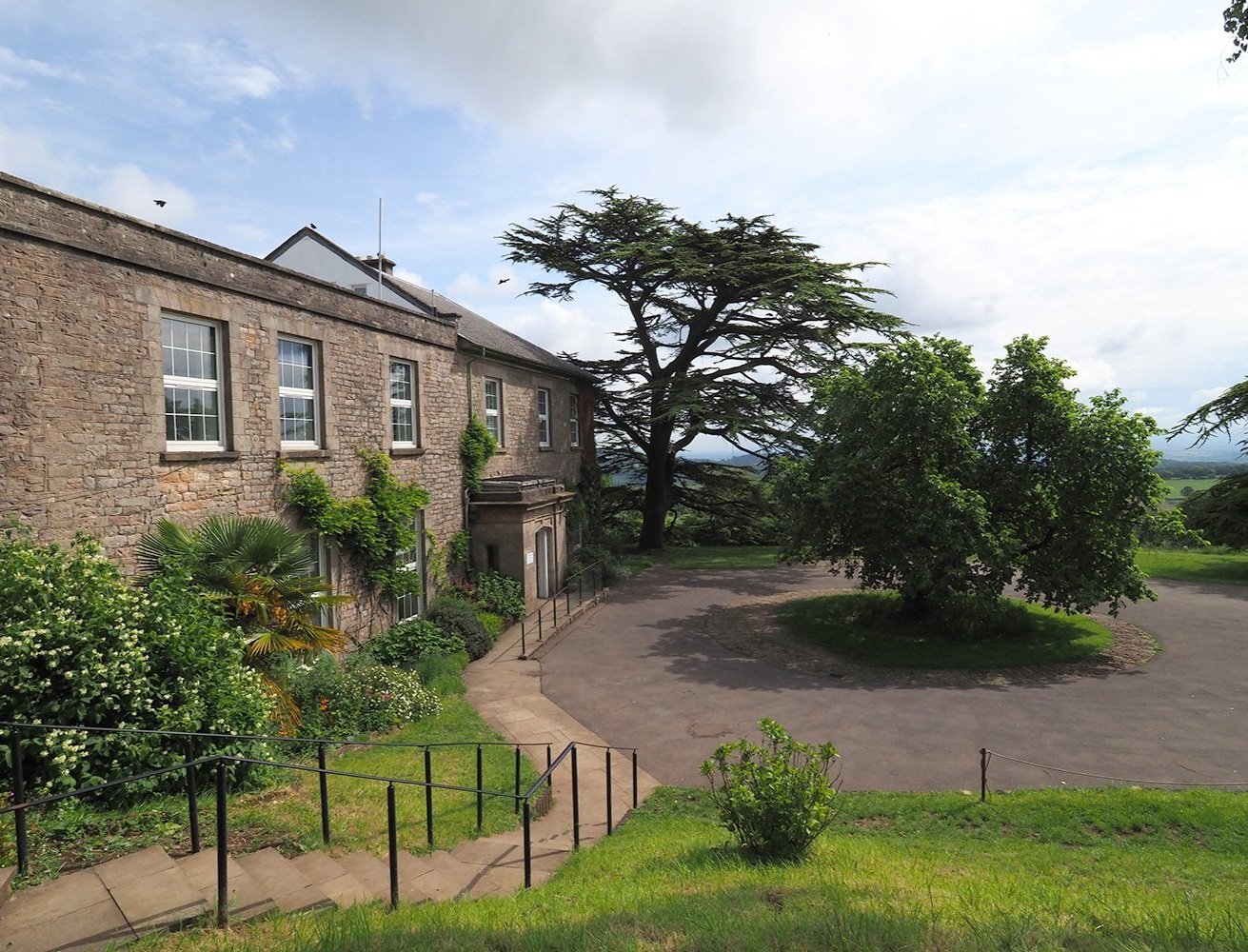
Wilderness Centre
The Centre considers itself a ‘home from home’ for its main visitors, younger school children, and sees itself as contributing to ‘flourishing lives’.
We have introduced regenerative thinking to the Centre so that it now sees itself as nested ‘within its place’, rather than simply being an outdoor learning centre that offers fun and challenging experiences. For the last four years it has been unfolding the potential of the 32 acres of nature it sits upon, including 5 acres of ancient forest.
Dartmoor ponies have been brought in to roam the fields, cattle do ‘conservation grazing’, wild boar that used to be seen as a nuisance, and as causing ‘damage’ are now welcomed for the seeds they surface for the wildflower meadows as they forage. Insect and bird life has soared. New hedgerows guide pine martins, stoats and weasels across the land as they continue their passage across the landscape. An extensive permaculture market garden is at the planning stage.
Bringing nature to life once more has added to the value offer of the business: children are growing ecoliteracy skills through a new quality of interaction with nature. While planting hedgerows for example, they are beginning to understand the unique role we have as humans in bringing ecosystems back to health. The schools rebook as soon as they leave. The children take new capabilities back to their school, their community, and to their families.
The local Council has taken notice, and can see the value in the Wilderness. If the region, the Forest of Dean is to transition to a new green, local and regenerative economy, then this will likely require the whole community to grow its ecoliteracy.
With the Council’s encouragement, the business has formed a Community Benefit Society to support this wider role. It has attracted considerable funding to buy the site from foundations enthusiastic about supporting so-called ‘bioregional’ projects, in our case, a learning centre that will do its bit towards reconnecting ‘bio’ (nature) and ‘region’ (our human geography which often takes for granted the land we live on).
Because it is also a living case study of a business on its regenerative journey, we also run a Regenerative Leadership course here at the Wilderness. Please see the ‘What We Offer’ tab and get in touch if you’d like to know more.
We cut our teeth with Kate Raworth’s pioneering work on Doughnut Economics while supporting a cross community group in Devon seeking to create a ‘Doughnut for Devon.’
We now bring the Doughnut to businesses keen to explore how they can make their contribution to a regenerative and distributive economy.
We offer an action-oriented workshop that is practical but ambitious focusing on the deep design of business. We begin with an exercise to introduce ‘living systems’ thinking to help business leaders find their compass to navigate the transition from our existing extractive paradigm to the new paradigm of regenerative business.
The workshop invites companies to engage in a transformative agenda of becoming regenerative and distributive in their strategies, operations, and impacts, so that they help to bring humanity into the Doughnut.
Central to the tool is the concept of enterprise design. This is explored through five design layers: a company’s Purpose, Networks, Governance, Ownership, and Finance.
These design layers powerfully shape the strategic decisions and operational impacts of businesses, and ultimately determine whether or not businesses can transform to become part of a regenerative and distributive future. By diving into five layers of deep design, this tool reveals both design blockages that prevent transformative action, and design innovations that can unlock its possibility.
Here's a short video to introduce the concept of enterprise design.

Bringing the Doughnut to Business
Hello, World!
What does the Bristol Avon Bioregion
have the potential to become?
A 1,750 km² catchment, read not as static geography but as a living, purposive process — and a case for a bioregional economy, a Charter of Rights, and a Learning & Discovery Centre to hold it all.

Five doors into the same river
This paper moves between established evidence, reasoned inference, and invitational, imaginative framing — deliberately, and (see the Appendix) transparently.1 Choose the path that matches why you're here; the contents on the left will highlight what's most relevant as you go.
Four essence patterns
This reading draws on a persistent strand in Western thought — from the Greeks through the Romantics to 20th-century process philosophy — that views reality as a web of dynamic, interconnected, unfolding moments of experience, where imagination and reason unite in the "creative advance"2 of the world. Read through geology, ecology, and social history, the catchment discloses four persistent patterns — each with its own climate imperative, and its own potential.
The Geological Pattern — The Constricted Loop and the Superimposed Escape
History. The Avon is geologically anomalous. It rises in the limestone of the Cotswolds and the chalk of Marlborough Downs and runs through clay vales, flowing south into Wiltshire, and then makes a dramatic, counter-intuitive U-turn back north and west, slicing through the carboniferous limestone gorge at Clifton to reach the Severn Estuary. This is a "superimposed" river system — it carved its way through solid rock layers from a prehistoric surface that has since completely eroded away.
Climate imperative. Because of this unique geography, the Avon is a massive, looping funnel. Water rushing off the Cotswolds and the clay vales of Wiltshire is throttled by narrow valleys and choked urban pinch points — Malmesbury, Chippenham, Bradford on Avon, Bath, and Bristol. As climate disruption brings intense atmospheric rivers, this geological loop acts as a giant structural trap, exponentially increasing the risk of further flash and systemic river flooding.
Potential. We cannot alter this deep rock geometry; therefore, the potential of the catchment is to become a Sponge-Organism. The river is calling to be allowed to expand laterally before it reaches the throttles — a massive, coordinated landscape transition transforming the agricultural clay vales of Wiltshire into a network of leaky dams, multi-tier floodplains, and continuous woodlands. This upstream landscape can deliberately hold, slow, and store the water, transforming the upper catchment into a protective lung for the down-river towns and cities, while also retaining vital water for nature and for food production. To prevent dangerous tributary peak synchronization, this lateral expansion must be dynamically mapped and sequenced through sub-catchment hydraulic modelling.
Appendix A notes flood risk in Bath and Bristol is multi-causal — rainfall intensity, catchment saturation, urban impermeable surfaces, drainage capacity and tidal locking at Avonmouth all matter at least as much as channel geometry. The "structural trap" should be read as one contributing factor among several.
The Ecological Pattern — The Fragmented Arterial Network
History. The Avon is fed by diverse tributaries — the Chew, the Marden, the Somerset Frome, the Bristol Frome, and the Biss. Historically, it was one of the most biodiverse lowland river systems in Britain, with many isolated evolutionary pockets. However, centuries of human engineering have severely modified its form: to fuel the Industrial Revolution and intensive agriculture, hundreds of mills, weirs and locks were built, while channels were straightened to drain land quickly. This fragmented the river, isolated its floodplains, and trapped agricultural runoff — phosphates and nitrates.
Climate imperative. In a changing climate, fragmentation is fatal. Rising summer temperatures warm static water behind weirs, lowering dissolved oxygen and triggering toxic algal blooms. Simultaneously, summer droughts threaten to dry out the headwaters entirely. If aquatic and terrestrial species are trapped in isolated pockets, they cannot migrate northwards or seek cooler, shaded refuges.
Potential. The catchment has the potential to become a Living Corridors Complex — the entire tributary network seen as a unified circulatory system, moving past routine conservation's isolated nature reserves. This means systematic, catchment-wide un-walling: breaching or bypassing obsolete weirs, daylighting urbanized tributaries, planting phytoremediation wetlands to filter urban effluents, and planting millions of climate-resilient trees along riparian buffer zones to cast shade and keep water temperatures down. The river becomes an unbroken migration superhighway for fish, invertebrates, and mammals escaping climate stress3 — with an obvious connection to JLTP4's active travel and green infrastructure commitments, river corridors doubling as walking and cycling routes.
Appendix A: weir removal involves real trade-offs — benefiting fish passage and reducing warm, low-oxygen pooling, but weirs can also maintain water levels supporting existing wetland habitat, navigation and abstraction. A catchment-wide programme should be understood as reach-by-reach assessment, not a uniform prescription.
The Social Pattern — The Hydro-Industrial Highway
History. Human interaction with the Avon has always been about exploiting its flow for movement and power. The Romans harnessed the thermal waters at Bath and built ports along its banks. In the medieval and early modern eras, Bristol utilised the immense tidal range of the Avon to become a global maritime trading hub. Later, the Kennet & Avon Canal mechanically bound the river to London. The social history is one of treating the river as hard infrastructure — a highway and a drainage ditch.
Climate imperative. This hard infrastructure mindset leaves modern urban populations entirely vulnerable. When heavy rain co-occurs with high tides in the Severn Estuary, the lower Avon suffers from "tidelocking" — the river water cannot escape into the sea and backs up into the streets of Bristol and Keynsham. The rigid, concrete relationship between urban citizens and the water creates a dangerous fragility.
Potential. The catchment has the potential to shift from a highway of exploitation to a Civic Commons of Ecological Co-Evolution — rewriting the social contract of the region. A Waters of the Avon Charter of Rights has already been endorsed by both Bath and Northeast Somerset Council and Keynsham Town Council.4 Through new governance structures — community-led catchment assemblies, and a progressive policy pathway toward legal personhood for the River Avon5 within such a Charter — the human population transforms from consumers of a water resource into conscious stewards. Urban planning must shift from defending against the river to making room for it: floating architecture, urban wetlands, and public spaces that accommodate the rhythm of flood and ebb.
New governance structures can build directly on civic engagement models pioneered by We Are Avon, scaling their work to transform the local food system — bridging urban consumer awareness and upstream agroecological production, so that human communities and the river lift each other up through how food is produced, distributed and consumed.
What the Avon Basin "wants to become"
Reconciling these patterns, the River Avon catchment is revealed to have the potential to become a Self-Regulating, Bioregional Organism. It is a place where the division between rural uplands and urban lowlands dissolves. Instead of rural areas polluting the river to grow food, and urban areas blocking the river to protect property, the catchment acts as a singular entity:
1. The Uplands and Vales (Cotswolds & Wiltshire) become a massive, public-wealth-generating mosaic of wetlands, re-meandered headwaters, and agro-forestry/ecology that acts as the region's climate shock absorber.
2. The Urban Settlements transform their riverfronts into porous, flood-resilient transition zones where human community and wild estuarine ecology overlap safely.
Through identifying and reconciling the bioregion's deep essence patterns, this is a uniquely situated, Western-derived practice — distinct from, though converging with, indigenous relational ontologies — using disciplined, scientific reason to manifest a deeply imaginative, resilient future already latent within the deep time of the Avon landscape.
"What does a self-regulating bioregional organism look like, sound like, feel like to inhabit? No strategy document can answer that question. Only art and the imagination can."The Reconciliation
The vocation: serving wider wholes
What the Avon catchment can become fully actualises only in relationship to the systems it sits within.
Regenerative thinking holds that life is nested — that every watershed, town and region can be seen as a living entity serving the wider wholes it lies within, so as to support more complex living processes. This is captured in the notion of a vocation. The vocation of the "Waters of the Avon" is rooted in its unique essence patterns, but that expression can actualise fully only when the watershed comes into relationship with its wider systems — receiving from the wider world the policy authority, patient capital and scientific knowledge it needs to begin, and offering back to that world the proof that it is possible. This paper proposes the region is called to be The Severn's Shock Absorber, a Climate Sanctuary, and Western Britain's "Future Living" Lab.
1. The Severn Estuary Bioregion
The Severn Estuary has the second-highest tidal range in the world, moving massive volumes of water, sediment, and energy. The Bristol Avon is nested directly within this macro-tidal environment. As a Shock Absorber, the Avon's upstream "Sponge-Organism" absorbs, buffers, and delays millions of gallons of water — stretching out the river's release time, allowing peak floodwaters to pass safely after the estuary's high tide recedes, and stabilizing water levels across the entire regional drainage system.
2. The Western British Ecological Highway
Migratory species — the critically endangered European eel, Atlantic salmon, and sea trout — rely on this water pathway to complete their life cycles. For centuries the river acted as a broken, fragmented road because of hundreds of industrial weirs, isolating wildlife populations. By implementing the Living Corridors Complex to un-wall the river, the Avon becomes a safe climate sanctuary: as rising global temperatures warm lower river channels, the Avon's tree-shaded, cool tributaries provide a vital pathway for aquatic and land species migrating northward to survive.
3. The Western Gateway Foundational Economy
Traditional, market-driven economic models separate these areas — treating Wiltshire as a place to extract agricultural profit and downstream cities as zones to be protected by expensive engineering. A novel approach to wealth creation does not just support the regenerative capacity of the Avon bioregion; it unlocks its true vocation. By linking economic growth directly to ecological health, the River Avon bioregion provides the Western Gateway with financial stability, infrastructure security, and a model for cooperative governance — turning the watershed into a living laboratory proving that a region can simultaneously increase its economic and its ecological complexity.
Bioregional wealth, not extraction
Funding the transition without triggering rural or working-class resistance means shifting from subsidy to bioregional dividends.
To fund a bioregional transition without triggering rural or working-class resistance, the economic model must shift from extractive6 capitalism — extracting value out of a place to enrich distant stakeholders — to generative bioregional wealth: circulating value within the catchment to enrich the ecosystem and its inhabitants. Wealth is reimagined not as a static pile of money, but as the capacity of an organism — the whole catchment — to experience evolution towards a higher state of flourishing. If the economic model leaves urban or rural workers behind, it creates systemic friction that stalls the entire transition.
1. From subsidy to bioregional dividends
UK land management is currently funded by fragmented, top-down grants or well-intentioned but misguided private green finance — distant corporations buying carbon credits from Wiltshire landowners — which keeps wealth concentrated at the top. Instead, a Bristol Avon Bioregional Wealth Fund is structured as a community-owned commons7: not a vehicle for outside investors to acquire land, and not a replacement for existing organisations or community groups. Downstream urban centres derive immense economic value from a healthy upstream river — flood mitigation, clean drinking water, tourism — so a localised Catchment Resilience Levy9 is applied to corporate footprints, water companies such as Wessex Water, and developers in Bristol and Bath.
A dedicated, legally protected percentage of the Levy and the Fund is ring-fenced to fully fund the administrative, operational and participatory costs of watershed governance — participating citizens and assembly representatives compensated with professional living wages, so stewardship does not become an elite luxury reliant on uncompensated volunteer labour. Revenue is redirected upstream directly to Wiltshire farmers, tenant smallholders and rural community land trusts, paying reliable, long-term living wages to act as "Sponge Guardians" — re-meandering streams, planting woodlands, restoring soil.
2. Democratising land tenure: re-commoning the land10
A significant driver of resistance to UK environmental initiatives is fear of land displacement and "green gentrification." Public and civic funding must be explicitly tied to Community Land Trusts, asset trusts, and robust Tenant Farmer Protections, so financial value circulates locally rather than being siphoned off by speculative developers. When public or civic capital transitions land into floodplains or agroforestry, that land enters community or civic co-ownership models — while the original farming family is offered a secure, multi-decade tenancy through a "Split-Interest" Model: a permanent Conservation Covenant (under the Environment Act 2021) leaves the freehold title with the farmer while securing permanent ecological governance for the community. Prohibiting future intensive agricultural or speculative housing use reduces the freehold's market value — achieving the core objective of a "Fairhold" model11 without requiring a deed transfer — after which a long-term Farm Business Tenancy (30+ years) is indexed to the land's newly established "ecological use value" rather than speculative market valuation.
3. A catchment-scale circular economy
Resistance often occurs because local people fear environmental change will destroy livelihoods — such as ending intensive dairy farming in Wiltshire. The continuous-cover woodlands planted to slow the water will, in time, become sources of sustainable timber; agroforestry farms generate diverse food, nuts, and wool. Processing facilities — sawmills, textile mills, food processing cooperatives — are deliberately placed in economically deprived post-industrial towns along the river networks, such as Trowbridge, Melksham, or East Bristol, so the wealth created by the landscape stays within the landscape. According to the New Economics Foundation, a pound spent in a regional independent business circulates around three times locally before leaving the region; a non-local pound circulates less than once.12
4. Overcoming resistance
Approaching a struggling tenant farmer or a resident facing a cost-of-living crisis with abstract ecological philosophy invites resistance as an elite luxury. Instead, the ecological benefit must be a direct solution to material hardship: for the urban resident, river restoration takes the form of a wetland park that reduces air pollution and summer heat-island effects and provides free public leisure space — directly lowering healthcare and cooling costs. For the rural farmer, the bioregional fund guarantees long-term price stability for regeneratively produced food, de-risking the transition by covering new equipment and providing peer-to-peer mentoring.
The new wealth feedback loop
Wealth creation is redefined away from GDP toward Gross Bioregional Vitality — measured through either the Commonland Four Returns or the UWE SERG Five Capitals framework8. By explicitly designing the funding mechanism to flow from wealthier urban nodes to rural and post-industrial nodes, the transition ceases to be a top-down environmental mandate and becomes a collective mechanism for regional economic survival and solidarity — where the human community and the River Avon lift each other up.
Sector vocations
What does the catchment's potential invite the region's technology, engineering, creative and skills sectors to become?
To weave Bristol and Bath's technology, aerospace engineering and creative sectors into this framework, each is invited to move beyond passive carbon offsetting or performative ESG branding, and ask: what capacities does the catchment's potential for becoming a self-regulating bioregional organism invite us to develop?
Building the Living Digital Twin
The tech sector develops, with local communities, a Bristol Avon Digital Twin — a real-time, participatory, open-source stream13 unifying the catchment's hydrology, soil health, biodiversity and weather patterns, currently fragmented across separate models. Revenue comes from licensing predictive environmental software14 to water utilities, insurers, infrastructure planners and agricultural cooperatives, creating high-skilled local jobs in Ecological Informatics. If a Wiltshire farming practice changes soil porosity, the Twin calculates the exact flood-risk reduction downstream in Bath or Bristol — data precise enough to justify and fund the Wealth Fund itself.15 It also integrates real-time agricultural data — soil organic matter, moisture retention16 — with public procurement, letting institutions like B&NES Council synchronise dietary supply with upstream harvests.
From Aerospace to Regenerative Eco-Hydraulics
With Airbus, BAE, Rolls-Royce and GKN anchoring the region's advanced manufacturing, a managed industrial diversification strategy pivots a percentage of this engineering capacity toward Eco-Hydraulics, Biomimetic Infrastructure and Landscape Engineering — treating the Avon as a living testbed. This means developing and exporting porous urban materials that eliminate runoff, and biomimetic, fish-friendly flow-control systems and micro-hydro turbines that adapt to changing river currents without disrupting aquatic life — protecting and expanding high-paying jobs in post-industrial South Gloucestershire and Bristol.
Architects of the Ecological Imagination
Bristol and Bath's natural history filmmaking, animation and immersive media cluster pivots from documenting global nature to shaping local ecological consciousness — across a technical-informational axis (VR, location-based media and public art making invisible hydrological systems visible; branding and civic tools for a Catchment Parliament) and a participatory-cultural axis, where socially engaged, place-based artists help communities process climate anxiety and cultivate relational kinship with the landscape. Figures like Mrs Meg Avon and practices like the We Are Avon pilgrimage breathe relational life into the Charter of Rights17, transforming the river from a policy object into a living neighbour in the public imagination.
Cultivating "Biocentric Intelligence"
The Regional Skills Strategy currently frames the workforce as technical components to be upskilled. An Eco-Informatics Curriculum instead pairs software and data analytics courses at UWE, Bristol and Bath universities with environmental science modules, training "Catchment Technologists" who can manage the Digital Twin. A regional low-coupon bond addresses the nineteen-fold retrofit "delivery gap" by giving installers a predictable, long-term project pipeline to justify apprentice investment. And traditional land-based skills — hedge laying, regenerative soil management, wetland engineering — are elevated to high-status, well-paid professions in areas like the Radstock and Midsomer Norton coalfield legacies.
Together, wealth created by tech, engineering and media no longer leaks into global financial markets — it anchors locally. Tech maps the crisis, engineering designs the physical solutions, the creative sector builds cultural consensus, and the landscape itself becomes safer, more beautiful, and resilient to incoming climate shocks.
A Bioregional Learning & Discovery Centre
Holding scientific rigour and felt, relational knowledge of the catchment simultaneously — without collapsing the tension between them.
Donella Meadows, who first proposed a network of global bioregional learning centres, named the most important capacity as the ability to hold scientific rigour — water quality data, flood modelling, carbon accounting, biodiversity indices — and felt, embodied, relational knowledge of the catchment simultaneously, without privileging either and without collapsing the tension between them into false resolution. Meadows also wrote of "leverage points to intervene in a system," noting the highest point is changing the mindset or paradigm from which the system arises. A Bioregional Learning Centre therefore cannot just train technicians; it must cultivate Bioregional Leaders — a reorientation from managing a landscape to inhabiting it, from solving its problems to activating its potential, from representing stakeholders to apprehending the catchment as a living whole.
1. Bioregional weaving (system convening)
Traditional leadership drives a single organisation forward. Bioregional leadership manages the spaces between organisations, and between organisations and the more-than-human life of the bioregion — bringing a corporate executive, a WECA policymaker, a South Gloucestershire tenant farmer and a We Are Avon activist into the same room, focused on the shared health of the 1,750 km² catchment and its exchange with wider systems.
2. Holding systemic friction (complexity navigation)
Traditional leaders try to eliminate friction with compromise; bioregional leaders use friction to spark creative solutions — reconciling the tension when downstream urban wealth collides with upstream environmental needs. This means holding space for "ecological discomfort" as well as human psychological safety: grief, loss, and the conflicting needs of different species, such as introducing a keystone species against local farming needs.
3. Evolutionary & place-based governance
This shifts top-down hierarchies toward polycentric stewardship — decision-making distributed across overlapping local groups. Emerging frameworks that "give nature a vote" as if it were a static human voter must be rethought: how do we govern if the river, the watershed as a whole, is a dynamic process of becoming? Rights of Nature must be taught not as static law but as living, evolving relationships — facilitating networks with distributed authority so that Sponge Guardians and urban Digital Twin operators co-manage regional resources without a rigid, slow-moving bureaucracy. Moving, in short, from governance of a place to governance as the place.
Art & the ecological imagination
No strategy document can answer what a self-regulating bioregional organism feels like to inhabit. Only art and the imagination can.
This reconciliation is not only an analytical proposition. It is an invitation to the artistic imagination — to painters who have stood at the Clifton Gorge, to musicians who have listened to the Chew in flood, to a poet for whom a particular hilltop is their muse, to filmmakers who have followed an eel through the fragmented waterways. A farmer who has brought to mind a dynamic picture of the watershed, or watched a film that makes the Avon's ecological history viscerally present, or stood before a painting that renders the Gorge as a living subject rather than a scenic backdrop, or heard music composed from the river's seasons — that farmer is already partway through a reorientation this document is pointing towards, without having read a word about regenerative practice or process philosophy.
Quick the struggling withy branches let the leaves of Autumn fly...
Ringers in an oil-lit belfry — Bitton? Kelston? Who shall say? —
Smoothly practising a plain course, caverned out the dying day,
As their melancholy music flooded up and ebbed away." Bristol · John Betjeman, 1945
what drover's mate
stood here in this lane to contemplate.
Dawn's coat cut by wings of swallow
our morning voices rise to follow...
It rained in the night
and it rained again,
it rained on root and leaf and stem.
The heart gets broken
the heart beats back
the heart is left on the drover's track." Drovers · Jon Hamp, the Kelston Roundhill Poet
Evidence base & open questions
This appendix distinguishes three registers used throughout the paper: established evidence (peer-reviewed science, statutory guidance, existing legal mechanisms), reasoned inference (extrapolation from evidence to catchment scale, not yet modelled or tested here), and invitational framing (philosophical, cultural and artistic language intended to open imagination rather than assert fact). Readers working in flood risk, hydrology, land management or law may wish to treat claims in the second and third categories as propositions for the transition assembly to test, model, and where necessary revise — not as settled findings.
A. On the "Sponge-Organism" and catchment hydrology
- Flood risk in Bath and Bristol is multi-causal. Channel geometry is real and relevant, but rainfall intensity, catchment saturation, urban impermeable surfaces, drainage capacity and tidal locking at Avonmouth are at least as significant. The "structural trap" framing should be read as one contributing factor among several.
- Natural Flood Management evidence is strongest for small-to-medium, frequent events. For the large, infrequent, saturated-catchment events this paper is most concerned with, upstream storage capacity may already be exhausted, reducing the marginal benefit of additional leaky dams and woodland. NFM reduces flood risk; it does not eliminate it.
- Attenuation timing needs sub-catchment modelling, not directional assumption — slowing water in one part of the catchment can desynchronise tributary peaks in ways that either help or worsen a downstream flood peak, depending on exact timing.
- Chalk and limestone headwaters behave differently from the clay vales, and need interventions designed separately from the "sponge" measures proposed for the vales.
- Weir removal involves trade-offs — benefiting fish passage but potentially affecting habitat, navigation, abstraction, or causing bed incision. A catchment-wide "un-walling" programme should be a reach-by-reach assessment process, not a uniform prescription.
B. On legal personhood and Rights of Nature
England and Wales currently have no operative legal mechanism for river personhood; this remains an international area of live debate and experimentation — such as the Whanganui River, New Zealand — rather than an available UK legal tool. References in this paper to "giving the River Avon legal personhood" describe an aspiration and a direction of travel, not a mechanism that currently exists in UK law.
C. On the Bioregional Wealth Fund and revenue stacking
- The Conservation Covenant model creates a "speculative discount" on the freehold's market value before offsetting revenue streams are secured. This paper does not yet specify what compensates the landowner in the interim, or who bears the risk if projected revenue underperforms — likely the single most important practical question for landowner uptake.
- UK guidance on biodiversity net gain and nutrient mitigation markets generally restricts stacking multiple payment schemes against the same intervention on the same land. The "Non-Extractive Revenue Stacking Formula" proposed here may not be permissible as currently described, and should be treated as a policy-change ask rather than an already-workable mechanism.
- Only bodies formally designated by the Secretary of State under the Environment Act 2021 can hold conservation covenants — WECA, Avon Wildlife Trust and BART would each need to secure this designation, or partner with an already-designated body, as a first practical step.
- 30+ year Farm Business Tenancies raise succession planning and lending questions; bankable tenancy terms would need input from agricultural finance specialists.
- "Ecological use value" needs a defined methodology — who sets it, how it is reviewed, and what benchmark it is indexed to is not yet specified.
This appendix is intended as a living document. As the transition assembly commissions modelling, legal advice and market analysis, findings should be used to confirm, refine, or retire the propositions above.
Footnotes
Referenced throughout the paper with small superscript markers — the connective tissue between the main argument and the sources, caveats, and side-doors it rests on.
References
A. Catchment reports
- Bath and North East Somerset Council (2024) Flood Risk Management and Types of Flooding. Bath: B&NES Local Flood Authority.
- Bristol Avon Catchment Partnership (2022) Bristol Avon Catchment Plan 2022–2027. Bristol: BACP.
- Bristol City Council (2020) Bristol Local Flood Risk Management Strategy. Bristol: Bristol City Council.
- Bristol City Council (2021) Avon Riversides 2100: Strategic Flood Risk Framework. Bristol: Bristol City Council.
- Department for Environment, Food and Rural Affairs (Defra) (2024) Sustainable Farming Incentive (SFI) and Landscape Recovery Scheme Guidance. London: The Stationery Office.
- Environment Agency (2012) Bristol Avon Catchment Flood Management Plan. Bristol: Environment Agency.
- Environment Agency (2018) Natural Flood Management Evidence Review: River and Floodplain Management. Report SC150005. Bristol: Environment Agency.
- HM Land Registry (2025) Land and Property Ownership Data Framework. London: HM Land Registry.
- Natural England (2024) Access to Evidence: Natural Capital and Freshwater Habitat Digital Catalogue. London: Natural England.
- University of the West of England / Sustainable Economies Research Group (UWE/SERG) (2023) Sustainability in the West of England Report. Bristol: UWE Bristol.
- West of England Combined Authority (WECA) (2019) West of England Local Industrial Strategy. Bristol: WECA.
- West of England Combined Authority (WECA) (2020) Joint Local Transport Plan 4 (JLTP4) 2020–2036. Bristol: WECA.
- West of England Combined Authority (WECA) (2021) Transport Delivery Plan 2021–2026. Bristol: WECA.
- West of England Combined Authority (WECA) (2022) Climate & Ecological Strategy and Action Plan. Bristol: WECA.
- West of England Combined Authority (WECA) (2023) West of England Growth Strategy: Priority Growth Sectors. Bristol: WECA.
- West of England Combined Authority (WECA) (2024) West of England Regional Skills Strategy. Bristol: WECA.
- West of England Combined Authority (WECA) (2025) West of England Climate Adaptation Report (ARP4). Bristol: WECA.
- West of England Combined Authority (WECA) (2025) Local Nature Recovery Strategy and Toolkit (LNRS). Bristol: WECA.
B. References by theme
- Legislation. Environment Act 2021, c. 30. London: The Stationery Office. (Statutory basis for Conservation Covenants — cited in the land recommoning section.)
- Systems thinking & bioregional learning centres. Meadows, D.H. (1999) Leverage Points: Places to Intervene in a System. Hartland, VT: The Sustainability Institute.
- Meadows, D.H. (c.1982) History of the Ideas Underlying the Balaton Group. Republished (2019) as 'The Bioregional Vision of Donella Meadows', Bioregional Learning Centre, South Devon. bioregion.org.uk
- Land tenure & finance. Parvin, A. (2020) 'A New Land Contract'. Open Systems Lab, Medium, 21 June. medium.com/open-systems-lab
- Commonland (n.d.) The 4 Returns Framework. Amsterdam: Commonland. commonland.com
- Ferwerda, W. (2015) 'Four Returns, Three Zones, Twenty Years: A Holistic Framework for Ecological Restoration by People and Business for Next Generations'. Rotterdam: IUCN Commission on Ecosystem Management / RSM.
- Local economic multiplier. New Economics Foundation (2002) Plugging the Leaks: Making the Most of Every Pound That Enters Your Local Economy. London: New Economics Foundation.
- Wessex Water / EnTrade. Wessex Water (2022) Innovation Report 2022. Bath: Wessex Water. corporate.wessexwater.co.uk
- Digital Twin / Earth Rover Programme. Earth Rover Program (2025) Earth Rover Program Launches Globally on World Soil Day. Exeter: University of Exeter Centre for Environmental Intelligence. news.exeter.ac.uk
- Forest of Dean UNESCO Biosphere. Forest of Dean District Council (2025) Forest of Dean UNESCO Biosphere Application. Coleford: Forest of Dean District Council. fdean.gov.uk
- We Are Avon, Conham Bathing & the Charter of Rights. We Are Avon (n.d.) River Movement. weareavon.com
- Conham Bathing (n.d.) Thriving Avon Charter. conhambathing.co.uk
This is a proposal, not a plan.
The paper closes with a call to gather a bioregional transition assembly — asking first, "who needs to be here?" This is where that conversation would begin.
Register interest in the transition assembly